Saturday, July 5, 2014

Transformer Education: Project-Based Learning in Disguise

How can project-based learning be like a Transformers movie?

Think about the Transformers movies.  They are grand spectacles that are highly entertaining visually.  We don't see these films because of the depth of the plot, the characters, or even the themes it addresses (though the first one could be analyzed for how it conveys an enduring understanding about the relationship between a teenage boy and his car).  We see these films because it is "cool" to see how the Transformers transform back and forth from a robot to a vehicle and because the visuals are like the art of a comic book panel coming to life.  The films are successful because they are dazzling.

The Transformers movies are also highly criticized for being empty and lacking any deeper meaning.  They are pure spectacle, which Aristotle defines in his Poetics to be the least important component of a dramatic tragedy, focusing on the sensory effects: costumes, scenery, the gestures of the actors, the sound of the music and the resonance of the actors' voices.   The substance of a drama is its plot, the "representation of human action" and one of the objects of the performance along with character (defining who the character or individual is) and thought (how the individual makes their decisions).  In essence, Aristotle believes tragedy is effective when it focuses more on substance than spectacle.

Can't the same be said about project-based learning?

Project-based learning is one of the most creative best practices, instructional methods, and active learning strategies we educators can use to challenge and engage our students to demonstrate and communicate their deeper knowledge, understanding, thinking, and awareness about the concepts and content they are learning.  It also supports education and performance in areas that are not considered (but should) to be the "core academic courses" - the fine and visual arts, career and technical education, and physical education.

Problem-Based Learning (PBL)
Since the 1990s, project-based learning has been emphasized, encouraged, and implemented in K-12 education to motivate our students to want to learn, to learn applicable skills that promote college and career readiness, and to support talent development.  Teachers proudly show the projects their kids do in their classes and for their assignments.  

How many classrooms and schools have we been in where the walls are decorated with the artistic works of the kids?  How many thematic nights have been presented by the school in which the library or cafeteria is turned into a museum featuring the dioramas and models designed by the students?  How many classroom performances have we been to where the students gave dramatic interpretations and presentations of what they are learning?  

We've even used project-based learning as a means of addressing the cuts made to the arts, career and technical education, and physical education in which the delivery of instruction is project-based learning.

Project-based learning is highly creative and promotes creativity.  However, does it foster and prompt creative thinking?

5 R's of Problem-Based Learning
BusinessDictionary.com defines creative thinking as "a way of looking at problems or situations from a fresh perspective that suggests unorthodox solutions (which may look unsettling at first)".  When our students are expected to think creatively, we're not asking them to draw, act, or sing.  We're challenging and engaging them to think about what they can design, develop, invent, innovate, plan, produce, or come up with to answer a question, address a problem, or accomplish a task.  These are the questions we need to ask students when we want them to demonstrate the highest level of cognition according to Bloom's Revised Taxonomy.

What Is Creative Thinking?
Creative thinking also correlates to metacognitive thinking, which Krathwohl (2002) explains as the process in which individuals think critically and strategically about how to use certain knowledge and skills accurately and appropriately and also develop self-knowledge and new ideas, perspectives, processes, and ways of thinking.  It is the ultimate level of acquired and developed knowledge that has students making decisions about how to use what they have learned or even coming up with new, innovate, and inventive knowledge about concepts and content they can validate through research, investigation, and hands-on learning.

Creativity is the medium, manner, or mode in which creative thinking is expressed.  This is what the projects are.  Each project a student produces represents the individual perspective and thought process of the person who designed the project - how they interpret the information, see the world, and share their vision.  This is why each project designed is unique to its designer or developer.  No project will typically be the same unless the student is expected to follow a set list of directions to produce a final product that has been already been defined and determined (for example, building IKEA furniture).  That's not a project.  That's a task.

The problem with project-based learning is that we focus more on the output or result than the process - or, in other words, we care more about what the student produces than the extent the student needed to research and investigate the necessary data, details, elements, facts, and information they needed to develop the project; the manner in which they designed the project; and the intended message of their project.  Instead, we typically judge a project based upon its aesthetics - how does it look and how well did the student meet the expectations for the task.

This is what I mean by Transformer Education: Project-Based Learning in Disguise.  Like the Transformers, we're focused more on the spectacle or presentation of the project than the level of thinking the student demonstrated and depth of knowledge the student communicated in designing the project.  The project highly entertaining, appealing, and interesting, but it lacks substance - like a Transformers movie.

Such project-based learning is merely "educational arts and crafts", an extension of what Calkins (1998) and Schmoker (2007) notion of "literary arts and crafts" that simply have students making "stuff" in the name of creativity and creative expression.  While I do not agree with Schmoker's notion that such learning is not purposeful, I do echo his sentiments that the creative expression provided through project-based learning that has students demonstrating their ability to create and communicate their depth of knowledge, understanding, and awareness of their knowledge and thinking must be more insightful and intellectual.

Another problem with project-based learning is that we often assign students the same project to do.  We have all students create a diorama, a model, a poster, a performance on the same concept, idea, subject, or topic.  Every student in class designs some kind of artistic representation of the solar system.  Every student writes a short story in the genre being studied in class.  Every student writes the same report.  Every student creates the same model of the atom.  Again, this focuses more on the output, production, and result than the thought process behind its design.

Critiquing project based upon their quality rather than depth also can cause conflict.  How many incidences have you experienced or heard about in which the parent confronted the teacher upset by the grade their student received on a project?  How many times have you found yourself questioning who truly designed the project - the student or the parent?  How many times have you encountered a situation in which the student addresses all the criteria of the project but the final product they turn in is a mess?  How many situations have you had in which the project becomes too overwhelming for the student or the project does not work properly on the day it is presented?  What do you do in those situations?

Project-based learning should not only be about the final product but the process in which the project is designed.  The emphasis should not be about how spectacular the project looks but rather how substantial are the concepts, ideas, subjects, and topics the final product addresses.  The evaluation should be not on the project itself but the level of thinking and depth of knowledge students expressed in their design, invention, plan, or production.

To engage students in deeper project-based learning, students should be expected to accompany each project with some form of communication - oral or written - that details the research involved in coming up with the project, the process in which the project was designed, and the intention or meaning the student hopes their project conveys.  I used to tell my students that this was the special feature on the Blu-Ray/DVD in which the director provides commentary how and why they set up a sequence of shots, the Behind the Music interview in which the musician explains why they wrote the song and what it means, or the interview with James Lipton on Inside the Actor's Studio in which the actor explains how they approach a role.  Not only does this serve as documentation of the work that went into designing the project but it also teaches students how to explain their ideas and thinking for all to understand.  This is what I would grade - the research and process behind the project.  That's creative thinking.

Whenever my students did a project, they had to accompany it with a research paper written in MLA format that defined what the concept or content the project addressed, the specific facts and information related to the concepts and content, and the credible sources they cited.  They also wrote a process paper in which they documented how they designed their project and identified the intended meaning and message behind the project.  These papers were like the placards that were featured with exhibits in a museum (In fact, in my dialogue - or rather, debate - with Mr. Schmoker about the academic merit of dioramas and projects, I asked if he would be more accepting of such activities if students were required to accompany their projects with documentation of their research and design process.  Unfortunately, we had to agree to disagree.).

Why Is She Smiling?
To model this process with my students, I showed them a picture of The Mona Lisa and asked them why she is smiling.  My students came up with some great hypotheses and ideas, but the truth is we do not know the answer because its painter, Leonardo Da Vinci, never provided any explanation nor left behind any documentation explaining what the painting meant, how he painted it, why he painted it the way he did, or what the intent, meaning, or message of the painting was.  Then I asked, "What impact does not explaining our thinking have on the world?" This was a topic I had my students write about and debate in class.  It also allowed me to make my point as to why they will be expected to write a research paper and document their process in designing their project.  They should not deny the world the meaning and method behind their genius and thinking (or madness, as I would jokingly tell them).  A creator can design, develop, innovate, invent, plan, or produce, but a creative thinker can explain the thinking behind their creativity.

The projects did not have to be grand scale models, visual presentations, or performances.  I informed my students that a project what a product that demonstrated and communicated their depth of knowledge, understanding, thinking, and awareness of what they have learned.  It could be a research paper, a report, or a personal narrative.  

The projects were long term projects that generally took the entire scope of the unit to complete, which was about four to six weeks.  The last week of the unit was devoted to project presentations.  Each student was expected to present their project.  If it was a project that needed to be experienced by an audience, it was presented to the class.  If it was a research paper or report, it was discussed in a Socratic seminar that the student who wrote the paper and I would facilitate.

I would grade the research and process papers the students submitted along with their project.  Then I'd let the students in the class grade the projects.

As I'm certain it is for many of you, I find it difficult to grade a student based upon the quality of a project - especially the more artistic it is.  There are some students who simply struggle with the ability to draw, to build a model, to sing, to act, to dance to stand up before a large crowd and perform or speak, or even to work with others in a group.  Perhaps that's not their area of strength, skill, or talent.   What am I doing by forcing them to do a project that may push them out of their level of comfort but backfires by asking them to do something they simply cannot do for whatever reason?

I also found it very boring and dull for me to grade the same project.  It became more tedious and time consuming for me to grade the project than probably for my students to do the project.  I also struggled with what exactly was I grading - the substance or the spectacle of the project?  Was I truly grading them based upon their deeper knowledge, understanding, and awareness of the concepts and content I taught them or was I merely comparing the quality of each project to another?

M.I.A.: World War II
That's why I gave my students a choice and voice when it came to project-based learning.  I used the Tic-Tac-Toe grid that's often used to differentiate instruction in project-based learning.  Each box represented one of the multiple intelligences defined by Howard Gardner.   I called this the Multiple Intelligence Activity grid or M.I.A.   However, instead of having the students choose three different projects that are listed diagonally, horizontally, or vertically, I would provide them a simple idea they could do for a project.  It was their responsibility to develop and expand upon the idea to make it their own.  
M.I.A.: Pythagorean Theorem
For example, for visual, I would say, "Turn the story we are reading into a graphic novel," or, "Write a song explaining how to apply the mathematical concept we are learning."  They could also choose whether they wanted to work on the project with a partner, in a group, or by themselves.  They could also choose to combine the projects to develop a project with a larger scope.  For example, turn an original short story written by one student into a graphic novel or a video.  If they didn't like any of the projects I suggested, they could come up with their own project and pitch it to me, explaining how it addresses the academic standards that needed to be met or exceeded in the unit (which I would identify at the beginning of the unit) and which driving questions the project would address.

  The students would evaluate the project by responding to the following question:

  1. What academic standards and performance objectives does the project address?
  2. What essential or driving questions does the project answer?
  3. What did you learn about the concept and content we have addressed in this unit from the project?
M.I.A.: Animals and Plants
Once the students turned in the responses, the student or students who developed the project and I would go over the responses.  If a percentage of the class were able to clearly recognize what standards and questions the project addressed and explain what deeper insight the project provided them, then that percentage was averaged into the grade I gave the student for their documentation of their research and process in developing the project.

Not only did it have the students feel as if they were involved in the decision-making of the class, it allowed me to determine just how deeply did the students understand the concepts and content I was teaching them.  If they could recognize, understand, and determine how these projects addressed the performance objectives and essential questions of the unit, then I knew they "got it".

M.I.A.: Science Fiction
As you can see from the M.I.A. activities I listed, the projects were pretty spectacular.  However, what made them substantial was the requirement for the documentation of the research and thinking behind the development of the project and also providing my students the choice and opportunity regarding how they would develop their projects.  I have some great artifacts from these lessons that I not only used as exemplar text in my classroom but also in my professional development trainings.  It's also nice to take the projects out from time and time and reflect upon how much these students enjoyed doing these projects.  Many of them even progressed to turn their experiences into a career, becoming engineers, artists, athletes, and performers.

This is how we can make project-based learning a more substantial experience not only for our students but us teachers and not have it become as spectacularly empty as a Transformers movie.

- E.M.F.

Tuesday, July 1, 2014

Going D.E.E.P.E.R. with Problem Solving and Problem-Based Learning

What exactly a problem?

Is it a circumstance that can be addressed?

Is it a condition that can be cured?

Is it an issue that can be resolved?

Is it a situation that can be handled?

Is a problem all these things, and can all problems be solved?

Not necessarily.

Most problems cannot be solved.  In fact, most problems in real life are only addressed, handled, resolved, settled, and even avoided.

Take a look at the articles featured in the newspaper, the stories in the news magazines, and the reports featured on the local, national, and cable news networks.  Each one is a real world problem that needs to be addressed, handled, resolved, or settled.  

However, education, school, and teachers teach us every question has an answer, every problem has a solution, and every task can be completed.

That's not problem solving.  That's solving problems.

Problem solving focuses more on the planning, process, thinking, and reasoning involved in addressing and handling circumstances, issues, problems, and situations rather than the solution itself.  The solution is the measurable example or outcome of the problem solver's thinking.  It is also not final or finite.  What is a viable solution presently may not be in the future.  With problem solving, as the adage goes, just when you think you have the answers, the question changes.

When we teach problem solving to solve problems, what we're actually doing is expecting students to attain an answer, conclusion, or solution.  What we should be teach students is how to think critically and creatively, examine and explore deeply, work collaboratively and responsibly, and communicate clearly their deeper knowledge, understanding, thinking, and awareness of the process of problem-solving.

Teaching problem solving involves students learning how to engage in two different processes we explain using the acronym D.E.E.P.E.R.

D.E.E.P.E.R. Problem Solving
D.E.E.P.E.R. Problem Solving involves students thinking strategically how to solve a problem by identifying what the problem is; examining and exploring all alternatives, options, and possibilities through research, investigation, and experimentation; picking the best solution; evaluating and explaining their thinking and reasoning; and reflecting and reporting on what they have learned through their education and experience. The ultimate goal is to find an acceptable or appropriate resolution or solution.  The scientific method is an example of how students would engage in D.E.E.P.E.R. Problem Solving.


D.E.E.P.E.R. Design
D.E.E.P.E.R. Design involves students thinking creatively how to design a plan or prototype of a product that will address, handle, settle, or solve a problem.  While the process is similar to D.E.E.P.E.R. Problem Solving, the end result is a plan or product that can be used to handle or manage the circumstance or situation. It combines both the critical thinking of problem-based learning and the creative thinking of project-based learning.  Engineering design is an example of how students would engage in problem solving using the D.E.E.P.E.R. Design method.


D.E.E.P.E.R. Review involves students analyzing and evaluating how a particular issue, problem, or situation was addressed, handled, settled, or solved and coming up with their own ideas and recommendations as to how they would deal with the problem. In these situations, the problem has already been identified and solved, and the student is expected to review how the situation was handled or what they would do with similar circumstances.  Case studies and literature reviews are examples of learning activities and experiences in which students would use the D.E.E.P.E.R. Review method of problem solving.  

The process and thinking students demonstrate and communicate depends upon the type of problem they are expected to address, handle, resolve, settle, or solve.  

Is this a well-structured, tame problem such as an algorithmic or mathematical story problem that has a clear, definitive answer?  

Is this an ill-structured, complex problem that engages students to choose from a list of possible and potential solutions, troubleshoot how to address the problem, come up with a diagnosis and hypothesize how to treat the condition, or think strategically and tactfully how to accomplish their goals within a certain time limit?  

Is this an ill-structured, wicked problem that continuously changes and evolves over time and has no clear or universally acceptable or agreed upon solution?

These are the types of problems students will encounter in their personal and professional lives.  Some problems may be difficult yet simple to solve, having a clear cut solution that takes time and effort to discover.  Some problems may be more complex, requiring students to demonstrate and communicate higher and deeper levels of knowledge, understanding, thinking, and awareness.  Some problems may be so complicated that finding an ultimate solution is near impossible.

So how can we develop problem-based learning activities that will teach students how to work with such a variety of problems?


Jonassen's Typology of Problems
Jonassen's Typology of Problems provides a framework of problem types we educators can use to develop deeper teaching and learning experiences that will teach our students how to work with the type of problems students will encounter throughout their lives academically, personally, and professionally.

Tame problems are the types of problems typically presented in school - problems that have simple, clear cut solutions.  What students should be provided are examples of the complex and wicked problems they will encounter in the real world.

Decision-making problems require students to make a choice from a list of alternatives, options, and solutions.  Examples of such problems would be choosing who to vote for in an election.

Troubleshooting problems expect students to figure out why something is not working and fix it.  Examples of such problems would be determining why an engine is not running properly and making the necessary adjustments to fix it.

Diagnosis-solution problems take a more scientific approach to troubleshooting, challenging and engaging students to use their education and experience to hypothesize what the problem is and how to treat the condition.

Strategic-tactical problems are goal-oriented and constrained by time.  Such problems occur in athletics and sports when the clock is ticking and the quarterback or center needs to determine how to execute a play successfully before time runs out.

Policy analysis problems have students examining actual laws, policies, and rules and determining their appropriateness and effectiveness.  Examples would be reviewing the amendments of the U.S. Constitution to determine whether the intent behind the law remains pertinent and practical or even the applicability of school rules and policies such as dress codes.

Designing and planning problems engage students to think critically and creatively how to fix flaws, innovate existing designs, or invent new plans and products that will make products work more effectively and efficiently.  Examples would be how to innovate the design and workings of a cell phone or computer or create a new product altogether,

Dilemmas are social problems that cannot be solved - only addressed, handled, settled, or avoided.  These problems are the most wicked and tenuous, involving so many stakeholders with multiple interests and investments in both the problem and the solution.  Universal acceptance of a solution is near possible, which is why such problems are so difficult to solve.  Examples of dilemmas includes issues involving education, immigration, politics, poverty, and socioeconomics.  The arguments surrounding the Common Core State Standards is an example of a dilemma that can only be addressed, handled, settled, or avoided.


The 5 R's of Problem-Based Learning
When developing a problem-based learning environment and experience, consider these questions that address the 5 R's of Deeper Teaching and Learning.

  • Rigor: This is defined by the performance objectives and learning outcomes documented in the Common Core State Standards, the Next Generation Science Standards, and the state content area standards.
  • Relevance: This addresses the "big ideas" of the disciplinary area and the enduring understandings of the concept and content being taught and learned.
  • Relationships: This identifies who or what can help the student solve the problem accurately and appropriately.
  • Results: This sets how students will demonstrate and communicate their ideas, reasoning, and thinking behind their solution.
  • Reflection: This engages students to consider how they can develop what they have learned and experienced into expertise that will  help them address similar issues, problems, and situations they may encounter in their academic, personal, and professional lives.
When developing problem-based learning activities and experiences, keep in mind the focus should be more on the process involved in addressing a problem rather than the solution itself.


- E.M.F.


Sunday, May 18, 2014

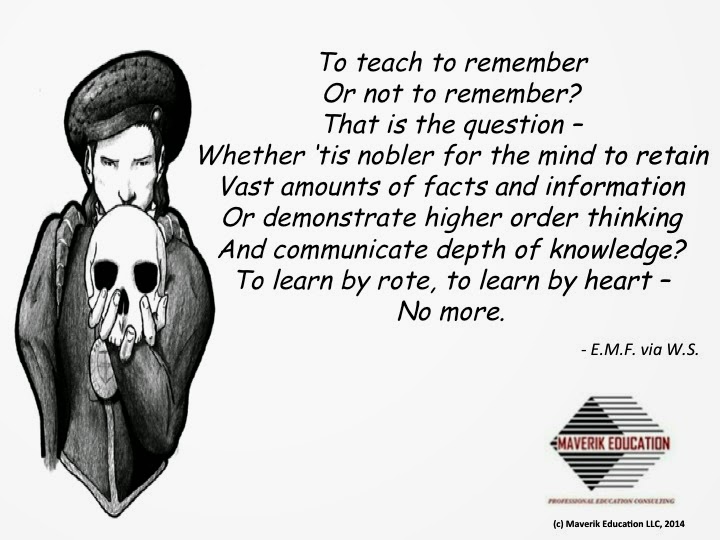
Don't Forget to Remember

Is there no longer a need to remember?

That seems to be the impression - or rather, misconception - based upon the educational research and literature that encourages and promotes teaching and learning that challenges and engages students to think analytically, creatively, critically, and strategically about what they are learning.  We educators are constantly being encouraged, prompted, and even pushed to have our students think about what they are learning.

However, remembering is thinking, too.

There's also a perception that students do not need to remember details, facts, and information.  They can just Google what they need to know or store all data and information on a computer from where they can access and retrieve the details and facts when needed instead of keeping it all in their head.

However, that's not remembering.  That's referencing or retrieving externally, which is correlated to remembering.  Remembering involves intrinsic referencing and retrieving data, facts, and information from the computer in our head -- our mind.  Search engines and computer hard drives allow us to store vast amounts of information and keep our mind open and free to think about the knowledge we have acquired.


Remembering is also not knowing.  When we remember, we are demonstrating and communicating our ability to recall, recognize, or retrieve from our memory data, facts, and information.  When we remember, we are also actively learning by defining, identifying, locating, naming, reproducing, and stating specific details, elements, procedures, terminology, and vocabulary.  Knowing addresses demonstrating factual, conceptual, procedural, or metacognitive knowledge of concepts or content.  In fact, in their revision of Bloom's Taxonomy, Anderson and Krathwohl (2001) separated knowing and knowledge into its own dimension within the Cognitive Process Domain.


The misconception about remembering is that we associate it with memorizing, which are two completely different concepts.   When we memorize, we are just committing  data, facts, and information to memory to use at a later time.   When we remember, we are drawing upon these bits of information from our memory to engage in deeper thinking that challenges and engages us to apply, analyze, evaluate, and create.

Memorizing is a process or way we remember, which is a very difficult yet simple process to commit facts and information to memory.  Interestingly, the way we remember things actually involve higher level thinking such as the following:

  • summarizing (understand)
  • making connections (apply)
  • associating (analyze)
  • correlating (evaluate)
  • designing or developing mental models (create)
  • drawing visual representations (create)
  • making acronyms, similes, and metaphors (create)
In fact, if you really think about it, when we're asked to remember something, are we not actually creating by picturing and visualizing models or coming up with original limericks, lines, saying or to make remembering easier?  How many of us know what the function of a conjunction is because of the song?  How many of us make acronyms to help us remember chronological order or processes?

Remembering also allows us to be self-reliant and responsible for what we know, understand, and can do without having to ask for help or seek out more information constantly.  There's nothing wrong about having a good memory or being able to remember things.

Remembering is the foundation as well as the launching pad of higher order thinking.  We can't demonstrate and communicate our ability to understand, apply, analyze, evaluate, or create without remembering the details, facts, and information that has been developed into background knowledge.  We can't think strategically about concepts, ideas, subjects, or topics without first demonstrating and communicating our ability to reproduce and apply learned facts and procedures.  We can't extend thinking across the curriculum and beyond the classroom without being able to draw from foundational knowledge.


So why is teaching and learning for remembering so controversial and contested?

Remembering is considered to be a lower-level thinking skill, and the term lower has a negative connotation.  Lower is not synonymous with easy.  In fact, remembering is much more difficult than the other categories within the cognitive domain of Bloom's Revised Taxonomy.  It takes a lot of effort to remember, which makes such thinking hard - or difficult.  However, the outcome or result of remembering is simple in that the response and result is very straightforward by being correct or incorrect.

When it comes to complexity, remembering is at the lowest level not because of the level of thinking but rather the depth expected to be demonstrated and communicated.  Remembering requires only recalling and recognizing facts and information.  Questions for remembering are closed-endedhaving one specific answer that is irrefutable and easy, quick, and simple to verify.  They are also convergent, requiring students to reproduce and apply facts and procedures to achieve or attain the one acceptable, correct response or result. 

However, when it comes to remembering, we must remember a few key facts.

Remembering is an essential skill.  There's no debate or doubt about it.  The ability to retain vast amounts of information is as impressive as being able to run a marathon or lift a heavy weight.  It's an admirable feat.  Remembering is also still highly respected and valued in society.  Being able to remember is a positive quality and trait.  People feel honored, respected, and cared for when a person can remember their name, stories they shared, or key events.

However, being able to use what you can remember is just as positive, respectful, and valued.

So what exactly all the fuss about teaching and learning for remembering?

It's not about remembering.  The fuss is actually about teaching and learning for memorizing.  We don't want our students to remember facts, information, and procedures in isolation.  We want them to remember these elements so they can develop background knowledge from which they can draw and establish connections within and beyond the classroom and curriculum.

Higher order thinking and depth of knowledge are the ideal.  It's what we want students to do with what they have learned and how deeply we want teaching and learning to go.  However, we still need to remember what is the information; remember who provided the information; remember where it is stored; remember why the information is needed; and remember how it relates to the question we are answering, the problem we are addressing, or task we are accomplishing.

When it comes to remembering, just think about this classic Eric Clapton song.


- E.M.F.